In the 70's, personal computers were a fresh idea. Your choice of computer was as much an individual expression as your choice of car. One of the earliest makers of complete computer systems was a small company called Ohio Scientific. They specialized in bare boards and kits for hobbyists, later focusing on fully built, integrated systems. I bought my C2-4P used in 1979, after hanging out at computer stores and drooling over PET, Apple, and the OSI challengers (and over glossy ads for the IMSAI, SOL, etc.) for a couple of years. The Challengers were perhaps the most conducive to hacking because of their spacious layout, modular design, and simple architecture. There are other sites that recount the history of these machines and the company that made them (see the links section.) Recently, I dug out my old C2, removed lots of blue wires, restored many traces (I would like to add a hacks page later) and got my machine back to the familiar C/W/M? prompt.
This archive is a repository for OSI thoughts, tips, tricks, hacks, literature and software. I'm attempting to arrange it in as sane a fashion as possible.
Your OSI doesn't work? Don't panic. . .
You can almost certainly fix your machine, perhaps with a bit of help. Even back in the day, OSI owners have traditionally, as a group, been familiar with the guts of our machines, and most have spent many a late hour chasing down bugs, hacking in hardware mods, and intefacing with foreign objects. And OSI machines are generally simple to understand and (usually) to fix.
To start, take a look at this article from Peek(65) Vol 6, issue 11. If you have a C1,C2, C4, C8, Superboard, or similar system, then check out the SAMS manuals (in the Manuals section below). Also, Prof. Mark Csele has a nicely illustrated discussion of some specific debugging hints on his web page. Also, check out the Tips and Tricks section below. Post on the OSIweb forums. Also, there are some online groups of vintage computer enthusiasts that don't specifically focus on OSI, but have accumulated wisdom about computer hardware, and probably more than a couple OSI enthusiasts. You may get some help on the classic computer mailing list (the cctalk list; check out http://www.classiccmp.org, and also check out the Vintage Computer Federation forums. You can also contact me directly by email, through the forums.
If you have an OSI, or OSI parts that you just don't feel motivated to repair or maintain, or OSI software or documentation that you would like to share with the world, then consider contributing it to the OSI archive.
If you want to just chat privately, you can email me at my osiweb.org address (dave, of course). Or register for the forums, and send a private message or email from there.
OSI Hardware
Third Party Hardware
Software
Journals
Manuals
Books
Ads and Catalogs
Tips, Tricks, Notes
Links
Credits
I welcome contributions, especially of software and scanned (or paper) manuals, stories, tips, tricks, hacks, and other info. I am also interested in working and non-working OSI hardware, either photos or the real thing. I am particularly interested in any information on the following:
Also, any information about, or working or non-working specimens of the following:
I'd love to hear from any other OSI'ers. Please check out the Forums section of the archive, and post any comments, corrections, or memories for all of us to enjoy! You can also email me privately via the Forums section.
07-Jun-2020: Added link to David Gesswein's OSI Floppy Test utility. Thanks to David for making this available!
06-Feb-2020: Added the Sams C2/C3 manual covering tons of OSI boards. Many thanks to Jeff Ferguson for the scan!!!
28-Jan-2020: Added Volumes 1 and 2 of the OSI UK User Group Newsletter. Many thanks to Pete Targett for the scans, and other useful info
15-Oct-2019: Added additional replacement part number for key switches, George Risk KBM-01-01, and added the datasheet as well.
10-Sep-2019: Fixed broken journal links and added missing descriptions for Compute's Gazette articles. Thanks to Mark S. for the prod
27-Jul-2019: Added link to John Lockett's utility for analyzing output of the Disk Dump Utility by Mark S.
03-Mar-2019: Added Aardvark Journal v3 n2. Thanks to Rene Chaddock!!
23-Feb-2019: Added the Fifth Book of OSI. Thanks to Steve Gray for the scan!!
18-Dec-2018: Added manual for the Okidata 3300 series hard drives, used in the C3 series. Thanks to Kristoffer!!!
18-Jun-2018: Updated the SYN600 ZIP file to include pre-built images for C1 and C2/C4, and added a DOS build script. Thanks to Steve Gray!
01-Mar-2018: Changed outdated MARCH links to VC Federation forums. Thanks to Evan K. of VCFED for the reminder
The most comprehensive listing of OSI boards, with variants and manuals, is the OSI Board Catalog at Mark's Lab. Definitely check the site out. I have collected schematics of several boards here, many from my own scans, several contributed by Mark, and several contributed by other kind OSI enthusiasts. Thanks so much to those who have contributed. I'm always looking out for more high-quality scans to archive here. Also, see Mark Spankus' OSI board catalog for more information and nice photos of many of these boards.
|
Board |
Description |
| 300 | Original OSI product. A 6502 trainer with 128 bytes of RAM, and binary switch programming, with two input lines and a 1-bit output latch. Designed as a learning tool, the manual is essentially a comprehensive introduction to bare-metal 6502 programming. Do check it out. Much thanks to Bill Dromgoole for the contribution! |
| 400 | OSI called this one the "Superboard." (The later OSI 600/C1 with video onboard was the Superboard II). A single board computer which could accept either a 6502, 6501, or 6800 as the CPU, with 1K RAM(eight 2102), 512 bytes EPROM/PROM (two 1702A, serial I/O (6850 ACIA), and a 40-pin user discretionary IC spot for a PIA, 6530, or any other chip, and an OSI 48-pin bus interface. A fully usable single board computer along the lines of KIM/SYM, without the keypad, with the bus expansion built in. Thanks to Bill Dromgoole! |
|
4K x 8- or optionally 12- bit static memory board, with (optional switched) battery backup. Courtesy of Bill Dromgoole. |
|
|
Super I/O board. 8 Parallel IO, UART Serial IO, RS232 / Cassette interface, 1 ADC w 8-channel multiplexer, 2 DAC, Z-unblank one-shot, fast pulse output. Courtesy of Bill Dromgoole. |
|
|
Early OSI video card,1K RAM, 32 x 32 characters, similar to C1P video. Can use a dedicated 420 memory card for 128 x 128 pixel graphics. Courtesy of Bill Dromgoole. |
|
|
Disk controller card. The interface contained a 6820 PIA for control lines, and a 6850 ACIA to read and write data to the disk. The board requires separated data/clock signals, provided by several 8" drives, but very few 5.25" drives. The MPI B-51 drive was the standard OSI mini-floppy, and held 40 tracks with 2k per track. There were many articles in PEEK(65) on how to improve the disk interface, build data separators, etc. Some of these are in the scan section. Also, the PIA could be populated alone, for use as a parallel I/O card. The second set of schematics showing the 470 configured as a single or dual sided floppy interfacee, and as a centronics interface, was contributed by Bill Dromgoole. OSI 470 gerber files on github: OSI_470.zip |
|
| 8-slot backplane for backplane-based C2-8P / C8P / C3 systems. Courtesy of Bill Dromgoole. | |
| 498 |
OSI 48-line bus card extender. OSI 498 gerber files on github: OSI_498.zip |
| 500 |
6502-based CPU with on-board 8K BASIC-in-ROM, ROM monitor in 3 x 1702 EPROMS (256 bytes each), 4K RAM as 16 x 2102 chips, 6850-based serial port with 20-ma current loop or RS-232 interface; 6820-based parallel port. Courtesy of Bill Dromgoole. |
|
502 |
Successor to the 500 board. 6502-based CPU with on-board 8K BASIC-in-ROM, 2K ROM monitor (with a complex addressing scheme to allow physical remapping of 256-byte ROM pages, to maintain compatibility with the 1702-based monitor code from the 500 board), 8K RAM as 16 x 2114 chips, 6850-based serial port with audio cassete, 20 ma current loop, or RS-232 interface. The parallel interface was dropped in this version. OSI 502 Gerber files on github: OSI_502.zip Jeff Ferguson's Build guide and log (with BOM) on Github: p502_Assembly_Instructions_and_Log.pdf |
|
505 Rev B |
Like the 502, but for disk-based systems. Omits the BASIC-in-ROM and the KCS cassette interface, but adds a 470-equivalent floppy interface. Thanks to Bill Dromgoole for the high-res scan! OSI 505 gerber files on github: OSI_505.zip |
| 510 | Triple CPU board used in the C3 series. Contains software selectable 6502, Z80, and a 6800. The Z80 can run OSI's port of CP/M. Scan by Bill Dromgoole. |
| 512 | OSI 512 board. Not sure what this is for. It seems to be some kind of FSK encoder that takes a clocked data stream and turns it into bursts of 4.7 MHz (mark) or 6.5 MHz (space). Perhaps this is part of the RF home control system? Any info is welcome. Contributed by Bill D. |
| 520 Rev C | 16K Static RAM board based on the SEMI 4200 4096 x 1 static RAM chip. Contributed by Bill D. Thanks! |
| 522 | 48K static RAM chip, based on the GTE 8104 1024 x 8 static RAM chip. Thanks to Bill D. |
| 525 | Dual port static RAM board. (Thanks to Jonathan for the contribution.) |
|
527 |
24K RAM board. With forty-eight 2114 chips, this board required it's own power supply, separate from the main supply. |
| 48K dynamic RAM board based on the 4116 16k x 1 dynamic RAM and the Intel 3242 dynamic RAM controller chip. Thanks to Bill D. for the scan! | |
| 540A (pic) |
Second-generation video board with 64x32 characters and guard bands (First generation was the 440, with 32x32 characters and no guard bands, similar to the circuit in the Superboard/Challenger I). OSIers loved this card because it was so hackable. |
| 540 rev B (pic) |
Design similar to the 540A, but adds 4-bits of color. Thanks to Steve Gray for the hi-res scan! Parts layout (last page) contributed by Bill D. OSI 540B gerber files on github: OSI_540B.zip |
|
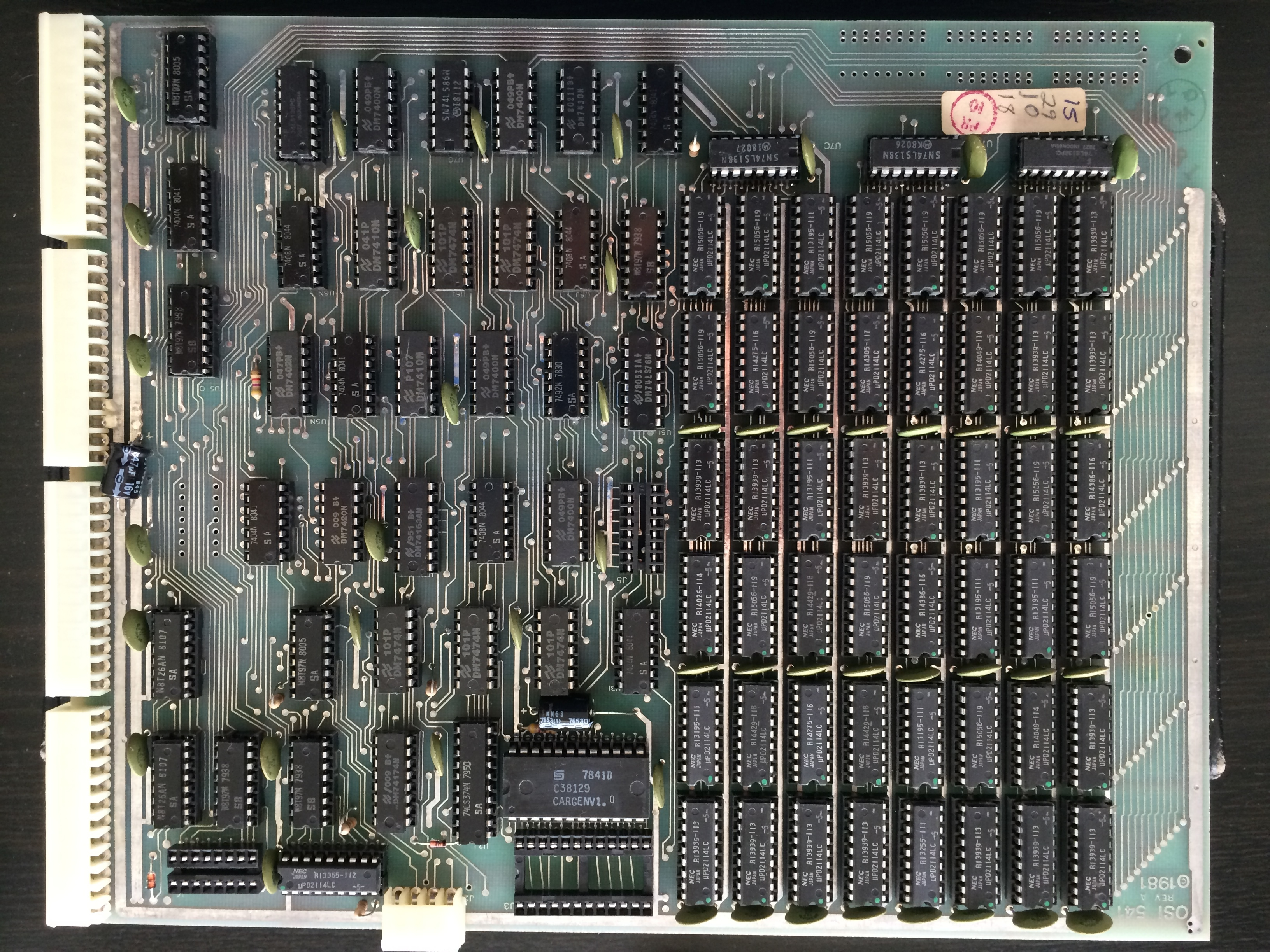
This is a High-resolution add-on offered by MA/COM as an add-on for systems with the 540B board, and as part of the C-100 system (which seems to be an upgraded C4P with high-res graphics option.) This info was supplied by Jeff Ferguson, who got one of these boards in his C4P, and was kind enough to supply high-res photos, and to reverse-engineer the schematics. Any addition info is certainly welcome. |
|
| 542 rev B 542 rev C |
Keyboard to accompany the 540B. Thanks to Steve Gray for the hi-res Rev B scan, and Bill D. for the Rev C scan! |
| 550 | 16 port serial board (for multiuser systems) (Thanks to Jonathan for the contribution.) |
| "Jungle Board" multi-function RAM+I/O board. I believe this was designed for the C3 multi-user and CPM systems. It contains 8K RAM in two blocks, 4 Serial ports, a "Network Node Interface" for multi-user systems, Centronics and NEC-wordprocessor compatible parallel interfaces. | |
| 560Z | "Processor Lab" board. This unique and remarkable board contains a Z80 and intersil 6100, with control of the 6100 and Z-80 chips by the host 6502, which can emulate I/O and other instructions to provide full PDP-8 emulation, Z-80 I/O compatibility, 8080 compatibility, etc. The 6202 assembly source code for PDP-8 IOT emulation, and Z80 I/O emulation is here. Courtesy of Bill Dromgoole (Thanks!) |
| 573 |
EPROM Programmer (head end card) OSI 573 gerber files on github: OSI_573.zip |
| Analog I/O head end card.solderless breadboard prototyping board (head end card) | |
| 575 | solderless breadboard prototyping board (head end card)
OSI 575 gerber files on github: OSI_575.zip |
| 580 | 8-slot extensible backplane (C2-8P, C8P, C3). Similar to the 480 board, but with ground pours on one side.
OSI 580 gerber files on github: OSI_580.zip |
| 582 | 4-slot backplane (for C2-4P, C4)
OSI 582 gerber files on github: OSI_582.zip |
|
Hard Disc controller board. |
|
| 592 | Hard disk interface. Contributed by Bill Dromgoole. |
| 596 | Hard disk interface. Contributed by Bill Dromgoole. |
|
600 |
Sold as the "superboard II", or with a case and power supply as the Challenger I. This was a single board system incorporating a built-in keyboard, 8K BASIC-in-ROM, 2K ROM monitor (without the complex remapping scheme), 8K 2114 RAM, 32x32 char video with 1K 2114 RAM (similar to the 440 card), and a serial port with audio cassette or RS-232 capabilities. Hook up a power supply and monitor, and this is a complete computer system, like an Apple II, but for $279. |
| Revision B of the 600 Board. Similar to the original. (Thanks to Frank for the contribution.) | |
|
Like the original, but with an extra 1k x 4-bit video RAM for color |
|
|
Like the rev C. Klyball's 600D reproduction gerber files on github: OSI_600D.zip. |
|
|
Expansion for the 600 superboard/C1P. Floppy interface, 24K RAM (Thanks to Mike P.) Klyball's 610 reproduction gerber files on github: OSI_610.zip |
|
|
Adapter card to interface the 600 Superboard II card to the OSI 48-line bus |
|
|
Color, I/O, interface board for 2nd generation C1P (Contributed by Mike P. Thanks!) |
|
| A13 | OSI disk cable adapter board. Mates with OSI 470, 505, 610 boards and third party disk interfaces. Contributed by Bill D. |
| A15 | Provides multiple ports for parallel I/O, parallel interface bus, joysticks. Mates with 505 board. Contributed by Bill D.
OSI A15 gerber files on github: OSI_A15.zip |
| Board | Description |
|---|---|
| D&N MEM-CM9 | D & N Products MEM-CM9 24K RAM (as 48 2114 chips) and OSI-compatible floppy controller card. This is equivalent to an OSI 527 card and a 470 card in a single slot. The RAM is addressable as an 8K block and a 16K block, which can be placed anywhere in the 64K memory space, and also can be assigned a RAM segment withing a multiple-64K memory space for a multi-user environment. (Courtesy of Steve Gray) |
|
8K RAM board. |
|
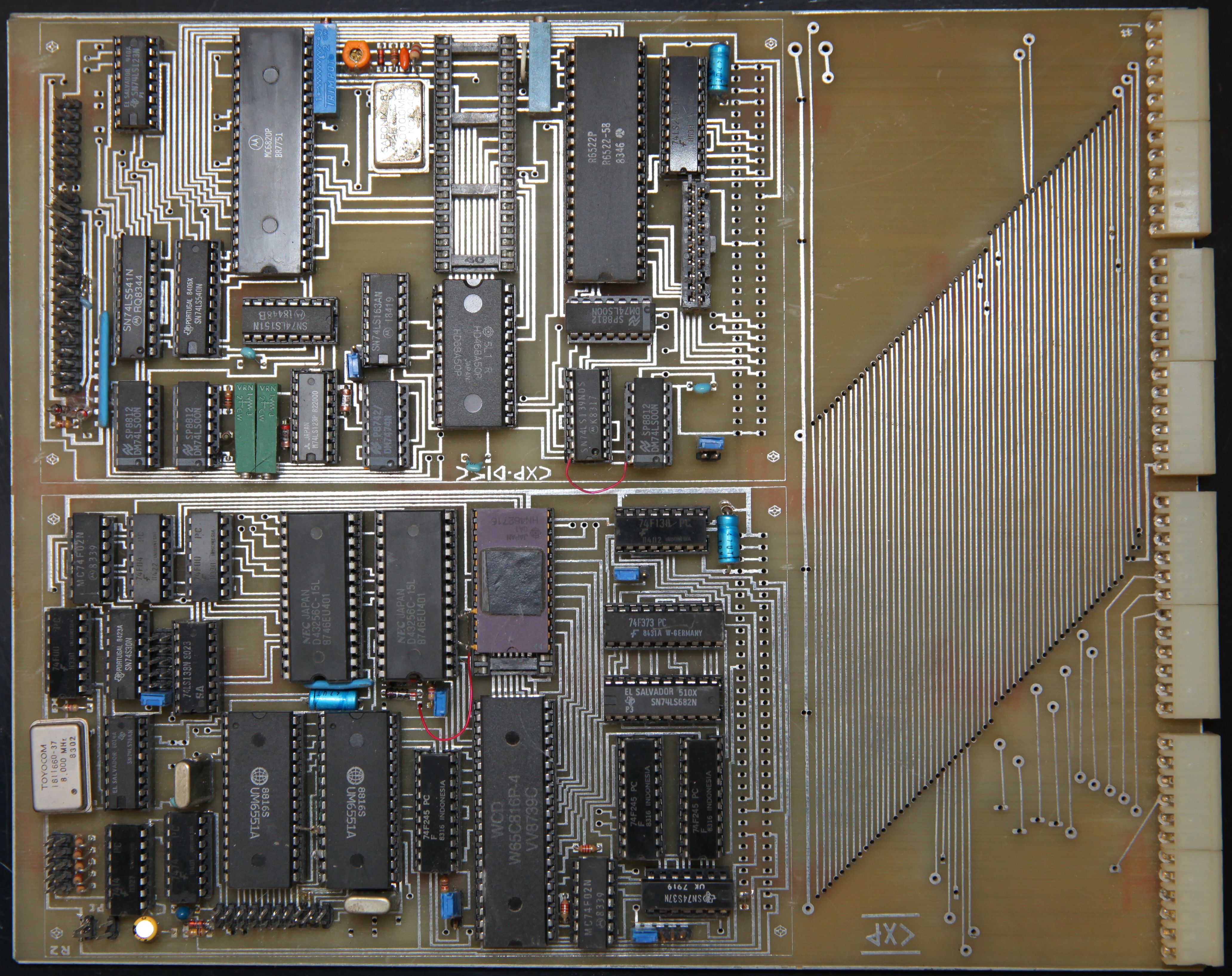
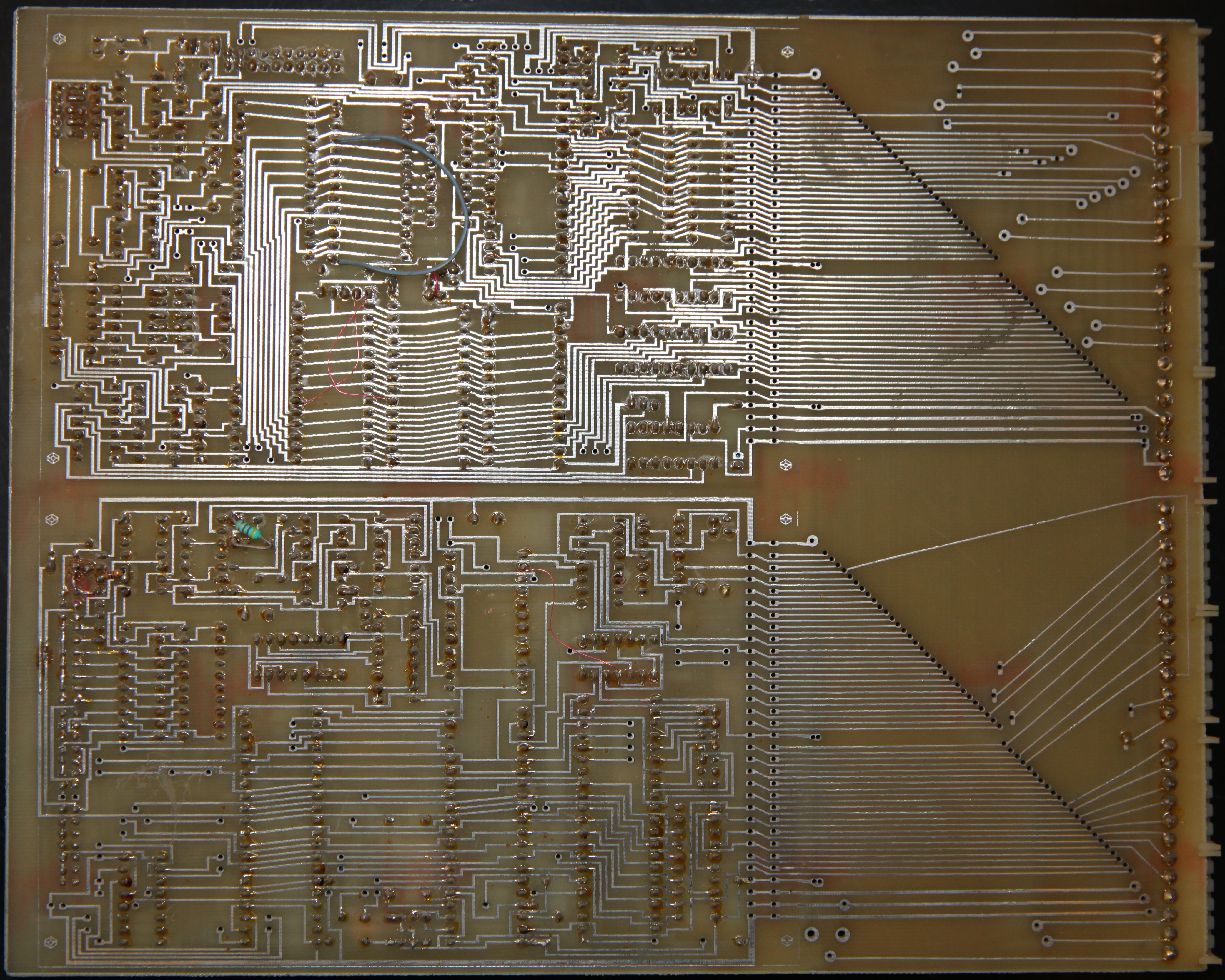
| CxP 16-bit OSI next-generation upgrade board, based on the WDC 65c802/65c816 processor, . Pictures courtesy of Scott Larson. See Forum thread here. Described in detail in Peek(65) V8 N1&2. Perhaps the only surviving speciment? |
| This is a package of schematics, notes, and errata for many of the OSI 400 and 500-series boards, as of 1977. Thanks to Paul Chidley for contributing these, by way of Steve Gray!! | |
|
A beginner's tutorial on 6502 machine-language programming, featuring the (primitive by any standard) OS-65V monitor program. |
|
|
Manual for the 500 board, including information on video and serial systems, interfacing, pinouts, etc. Thanks so much to Bill Dromgoole for this contribution!" |
|
| Very brief list of OS-65V commands | |
|
The C4P User's manual. Shipped with C4P systems. |
|
| C1P Manual | The C1P User's Manual - (thanks to Mark) |
| C1P and C1PMF Introductory Manual | An introductory manual for the C1P series II. Thanks to Steve Gray for the scan. |
| Detailed step-by-step assembly instructions for the SUperboard II. Also applies to the Klyball 600D clone. Many thanks to Jeff Ferguson for acquiring and scanning this!! | |
|
Looks like a scan of an older version; longer, but with plainer typesetting. Much of the contents appear similar. |
|
|
The reference card included with my shiny new OS65D binder when I got my disk upgrade. |
|
|
A scan of a bootleg version of the (I believe) Aardvark notes on ROM Basic. If you have a better version, let me know! |
|
|
This is the better, full version of the Aardvark notes on ROM BASIC. Thanks to Bill Dromgoole!! |
|
|
A very thoroughly annotated disassembly of OS-65D. Every little trick, bug, secret, and wart is exposed. If you're looking into any OS-65D mods, development, or disk interfacing, this is your resource. |
|
|
This is the manual for the Microsoft 8K ROM Basic (rev 3.2) that shipped with the C1/2/4/8 machines. |
|
|
Usermanual for OS65D v3.0. (Thanks to Frank) |
|
| OS65D Tutorial and Ref Manual | Tutorial and reference for OS65D. The original OSI-supplied documentation. (Thanks to Mike P.) |
|
SAMS repair manual for the Superboard II/C1P/C1PMF. This is for the original version with the black and white video output, and covers the 600 CPU board, as well as the 610 Disk/memory card. Thanks to Jeff Ferguson for these scans!. |
|
|
This is the SAMS repair manual for C2/C4, including 502, 505, 527, 540, and 542 Boards. Full color. Thanks to Jeff Ferguson for these scans! |
|
|
This is the SAMS repair manual for many C2/C3 OSI boards. It covers the 470, 505A, 510C, 520B, 520C, 525, 527, 535, 550, 555, 590, 592, and 594 boards. Full color. Many thanks to Jeff Ferguson for these scans! |
|
| User manual for the CEGMON replacement monitor ROM. Thanks to Graeme! | |
| Hexdos User Guide | User guide for the HexDos mini-os for the C1P. Contributed by Graeme! |
| MPI B51 Drive Manual (Short) | This is the drive used by OSI for all their 5.25" drive models. The short version of the manual has a lot of useful information on maintenance, but does not include complete schematics. |
| Okidata 3300 Hard Drive Manual | This hard drive was used in OSI hard disk systems. These drives ranged up to 80 MB unformatted. Thanks to Kristoffer! |
| MPI B51/B52_Product Manual (Long) | This is the drive used by OSI for all their 5.25" drive models. The manual has a lot of useful information on maintenance, as well as complete schematics, theory of operation, etc. |
| Hazeltine 1500 Maintenance manual | This is the comprehensive maintenance and service manual for the Halzetine 1500, 1510, and 1520 terminals. Very large file! |
| Micro on the OSI | Compilation of Micro articles for OSI |
| Elcomp - First Book of OSI, scanned and contributed by Stephan (stm). Lots of articles on OSI machines, compiled form various sources. | |
| Second Book of OSI index | Contents of the second book of OSI. Scanned and contributed by Mike. |
| Third Book of OSI | This is based on an expansion system for 6502 micros. Articles describe the ELCOMP expansion bus, and projects based on the bus: 6522/6520 I/0, EPROM programmer, Sound card, memory cards, A/D converter. It seems useful, but not much OSI stuff that can stand on its own. |
| Fourth Book of OSI index | Contents of the fourth book of OSI, Scanned and contributed by Mike. |
| Fifth Book of OSI | This is a collection of articles, programs, and tips for the OSI C1/C2/C4 machines. Many thanks to Steve Gray for the scan!!. |
| Aardvark's First Book of OSI | Aardvark's first book of OSI, lots of misc. info on OSI systems. Scanned and contributed by Bill Dromgoole. |
| OSI BASIC in ROM | An introduction to OSI (Microsoft 6502) BASIC in ROM, along with in-depth discussion of variable and program storage and other under-the-hood details. Contributed by Jeff Ferguson. |
| Aurora Software | Aurora Software Associates catalog, spring/summer 1981. Games, utilities, and more. |
| Cleveland Computer 1981 | Cleveland Consumer Computers & Components 1981 catalog. OSI dealer with great descriptions of the systems, and great Q&A section at the end. Thanks to Danny! |
|
Omega Science OSI dealer price list for Sept 1980. Thanks to Steve Gray! |
|
|
List of OSI Disk and Cassette software. Thanks to Steve Gray! |
|
| OSI May 76 Catalog | Contributed by Bill Dromgoole. This is a very early catalog( The first OSI magazine ad of which I'm aware is from Feb 1976.) Includes the OSI 300 trainer, OSI 400 board, 410 board, 440 board, and the 480 backplane (shown interfaced to a Kim-1!) |
| OSI Winter 76 Catalog | Introduces the Challenger line, based on 400-series boards. The 470 floppy system appears here, as does the 460Z with the 6100 and Z80, plus a spot for another microprocessor of your choice. Thanks to Bill Dromgoole! |
|
OSI spring 1978 catalog: C3 systems including 74MB winchester. C2 systems. Still offered the 500 CPU and the 440 video board. No superboard or C1. |
|
| OSI catalog, circa 1980 | Two years later, C2 is gone, C3 is not included in this catalog, lineup is heavy on C4/C8, with C8 targeted at business. Bullet points include speed of execution of an ADD instruction (600 ns). C1 is mentioned as an entry level machine. |
|
Ad from Micro (Dec 1982) for the Orion Super Expansion boards, a series of video cards with advanced capabilities relative to the OSI native graphics, with additional I/O features. If anyone has any info on these boards, let me know! |
|
| Orion Software Catalog | Orion Software Associates catalog. Games, utilities, and office applications (by Dwo Quong Fok Lok Sow). Contributed by forum member Danny. |
| An ad from the final days of the OSI systems. The C-100 appears to be a C4 with an additional high-resolution add-on card. |
| OSI App Note #1 |
Discusses adding a 6530 with the TIM monitor to the OSI 400 Board. Courtesy of Bill Dromgoole. |
|
Discusses OSI system expansion. This is aimed at the 400 board, but applies to the later 500 series boards as well, and to expansion for the 600 board. It discusses memory map, the OSI 48-line bus, the 480 backplane, and more. This is also the manual for the 480 backplane board used in C2-8P and C3 systems. Courtesy of Bill Dromgoole. |
|
|
Series 400 construction hints (applies to all OSI boards.) |
|
| OSI App Note #4A |
6502 Clock circuits |
|
A list of known OSI boards. If you have additions, let me know! |
|
|
Notes on replacing 4116 triple-supply chips with 4164 5V-supply chips, which are also cheaper and easier to find. Lifted from the video-game repair community archives. |
|
| Keyboard Switch Repair | A beautifully detailed guide to repairing the key switches. Large PDF, but worth the download. Lots of pictures. Thanks to Josh for the contribution! |
|
Notes on the Disk driver routines for OSI Disk BASIC |
|
|
A few notes on various OSI Roms, by Mark Spankus. |
|
|
More notes on the OSI ROM, including a nice description of the addressing scheme, excerpted from Peek(65) v5n1 Jan 1984 |
|
|
Notes on modern replacements for hard-to-find OSI components |
|
|
How to modify a 502 board (and CEGMON ROM) to use the CEGMON monitor with minimal surgery. |
|
|
Instructions for converting C1 display to 64 x 32 (no guard bands). Two versions, contributed by Frank and by Jeff Ferguson. |
|
| Superboard/C1P 32/64 char mod | Progressive Computing's C1P/Superboard II mod for full 32 chars/line with guard bands, and once you have that, a 64 char/line mod. Thanks to Jeff F. If this is interesting, check out another 32/64 char mod with guard bands published in Peek(65) Vol 5 No. 2, and Vol 5 No. 3. |
| C1P Video multiplexor | Instructions for an add-on circuit to allow selection between 32 and 64 characters per line on SBII/C1P systems modified for 64 chars/line. Contributed by Jeff F. |
| C1P Speedup | Instructiosn for speeding up the SBII/C1P, from the Feb 1980 issue of MICRO. Contributed by Jeff F. |
| OSI600_RAM_ROM.zip | C1P/600 board mod for 32K on board. Moves BASIC to a single 27C64, and adds a 32K RAM chip. |
| C1P Sound Board | Instructions for wire-wrapping a Sound board for the C1P, based on the TI 76477 sound chip. Contributed by Jeff F. |
| Single Disk Copy | Article with routine and instructions for single disk copy. Courtesy of Thomas B. Owen |
| C1 Light Pen (Aardvark) | Article with instructions for building a light pen for the C1, and example BASIC program. Thanks to Steve Gray! |
| Bills Micro Services Memory Map for C1 | List of important ROM software memory locations for the C1. Thanks to Steve Gray! |
|
OSI Software and hardware sources, PCB reproductions, new projects. |
|
|
An excellent pan-OSI emulator for Windows, WinOSI, by Mark Spankus. Mark also has plenty of other goodies, many of which are on this site. Much material on this site was contributed by Mark (unattributed, unfortunately) |
|
|
A comprehensive utility for testing floppy disk drives. Supports video and serial-based systems. |
|
| C1P.js | Jeff Parson's Javascript C1P emulator. This has a built-in debugger, and other goodies. Run it right in the browser! |
| UK101 emulator | UK101 emulator written in Java, by Tim Baldwin. Actively developed as of Feb 2017. |
| Lots of great OSI info, including many beautiful hardware photos, and detailed descriptions of several hacks and mods to get your machine up and running. Very helpful. | |
|
Great C4P and Superboard II pictures and scans, including some uncommon hardware and custom cases. |
|
|
A comprehensive site dedicated to the Compukit 101, with plenty of scanned articles, manuals, software, and an emulator. |
|
|
Another nice compukit 101 site, with pictures. |
|
|
A C1P site with a C1P emulator for windows |
|
|
OSI Disk Dump utility - A very useful utility for analyzing 8" OS65D disk dumps (from Mark Spankus' dump utility) and for generating images from dumps |
|
| Tezza's C4P Adventures | Terry Stewart's Summer 2014 Retrochallenge project--Repair and restoration of a C4P cassette system, with lots of pictures and other info. Take a look at the rest of the site as well. |
| Bill Degnan's VintageComputer.net | Lots of great detail photos of OSI systems. From the main page, click "Directory", then "OSI". Don't forget to check out the plethora of other systems! |
| vintagecomputer.net | Historical Computer Restoration website, by Bill Degnan. Lots of interesting hands-on restoration photos and discussion. Great site. |
|
A resource for 6502 programmers. Useful resources include a code library, forums, and hardware designs. |
|
|
A free, maintainted, mature C compiler, assembler, linker, and utilities for the 6502, with a target for the C1P by Stephan (stm on the forum). Way to go Stephan! Documentation on the C1/Superboard port is here. |
|
|
A very powerful binary file manipulation utility. It reads and writes numerous binary formats, including OS65V, and can write BASIC DATA and assembler .db statements. |
|
|
Recompilable disassembly of Microsoft 6502 BASIC, with conditional asssembly switches, which can assemble to several byte-accurate versions of Microsoft 6502 BASIC, including OSI (including the GC bug), Commodore (v1 and v2), Applesoft (v1 and v2), KIM-1 basic, and more. Very interesting. This site contains a large number of other interesting articles as well. |
03-Dec-2017: Added scans for the WP3 manual and the manual for the OSI 574 analog I/O board (CA-22)
25-Nov-2017: Added better quality scans of all the previously available Aardvark Journal. Many thanks to Steve Gray!
25-Nov-2017: Added several new Aardvark Journal scans contributed by Steve Gray. The collection is almost complete. Thanks, Steve!
16-Nov-2017: Added Superboard II assembly manual. Thanks to Jeff Ferguson for the scan!!
16-Nov-2017: Added Aardvark Tiny BASIC Compiler listing to SOFTWARE section. Thanks to Steve Gray!
16-Nov-2017: Added more TOSIE Printout scans. Many Thanks to Steve Gray!
28-Apr-2017: Added manual for OSI Chess. Thanks Stephan!
10-Apr-2017: Added Klyball's 600D and 610 reproductions PCB gerber files.
02-Apr-2017: Added links to Gerber files for 470, 498, 502, 505, 540B, 573, 575, 580, 582, and A15 boards!
02-Apr-2017: Previous wish for examples of running 560Z boards came true!! see forum thread and this link for Glitch and Klyball builds!
27-Feb-2017: Added two more Aardvark catalogs, and the WEMON monitor ROM for C1P/SBII/UK101. Thanks to Steve Gray!
27-Feb-2017: Added proper attribution for Omega Sciences price list and OSI Software Handout--Thanks Steve Gray!
08-Feb-2017: Added link to Tim Baldwin's java UK101 emulator
20-Sep-2016: Added WP2 disk image (for C2/4/8, 5/25"). Thanks to Mike for the contribution! Original image by Mark Spankus. WP2 Manual also added.
17-Sep-2016: Added WP6502 (Duo Quong Fok Lok Sow) manual, disassembly listing, and review.
17-Sep-2016: Added HexDOS image and manual to software Section. This is a bootable image created form source, contributed w/manual and newsletter scans by forum member Danny. Thanks!
17-Sep-2016: Added numerous scans: catalogs (orion, aurora), multiple C1P mods, and OSI BASIC-in-ROM book contributed by Jeff Ferguson--Thanks!
17-Sep-2016: Steven P. Hendrix has contributed the source code for HexDos 4.0 to the OSIWeb GitHub for non-commercial use. Thanks so much!!
17-Sep-2016: Added FBASIC disk image to FBASIC software section. Thanks John!
17-Sep-2016: Added the Aardvark First book of OSI. Thanks to Bill Dromgoole!
17-Sep-2016: Added several scans by Bill Dromgoole, including the 520, 522, 535 RAM boards, 510 triple CPU, and many more.
17-Sep-2016: Added Elcomp's First Book of OSI. Thanks to Stephan! There have been a large number of contributions from many folks over the past year, and I will be adding them as I am able.
27-May-2015: Added FBASIC manuals (version 1.0 and 1.1), and the intro for a FigForth for OS65U manual. Many thanks to John, from the forum, for these long sought after contributions!!
27-May-2015: Updated replacement parts list to include replacement for keyboard switches. (Thanks to Grant and to Bill Dromgoole)
15-Mar-2015: Added WinOSI-compatible disk images for C1P versions of the OS65D v3.3 tutorial disks, and an OS65D v3.1 boot disk, prepared by Grant (Klyball) from the C4P images. The library is growning!
8-Mar-2015: Added multiple WinOSI compatible disk images to the software page. Huge thanks to Phil for gathering and preparing these, and for making them available to everyone! Also, thanks to Eric Klein (of vintage-computer. com for making the disks available for imaging.
6-Mar-2015: Updated the cc65 link to the new github reposityor, and removed the "No OSI port" statement, which Stephan rendered obsolete by doing the port. Big thanks to Stephan!!
5-Mar-2015: Added the "Ohio Scientific Comprehensive Information Package II". Thanks to Paul Chidley for donating the documents, and to Steve Gray for making the high quality scans!!
13-Jan-2015: Finally added a link to Jeff Parsons' very cool Javascript C1P emulator. Awesome, Jeff!
6-Dec-2014: Added pictures of the CxP CPU board, courtesy of Scott Larson. Thanks!
5-Dec-2014: Added many new files contributed by Mike from NZ, the second home of OSI. Several BASIC enhancement ROMS from Premier Publications, A ROM word processor (Word Wizard 3) for UK101/C1P, Specially patched OS65Dv3.3 disk images for the C1P and C4P (8 inch disk images), and table-of-contents scans from the Second Book of OSI and the Fourth Book of OSI. Mike uploaded these over a year ago, it's about time I posted them. Thanks Mike!!!
1-Aug-2014: Added info for the 541 board, a 512 x 256 high-res add-on for the 540 board, thanks to Jeff Ferguson, who reverse engineered the schematic (!) Thanks!!
30-May-2014: Added the OSI 500 board general purpose manual, scanned and contributed by Bill Dromgoole--Thanks Bill!
27-Jul-2013: Added DABUG ROM to the firmware section. Thanks to Leslie Ayling for discovering and preserving this!!
11-Mar-2013: Added two catalogs (May 1976, Winter 1976) contributed by Bill Dromgoole. Thanks!!
25-Feb-2013: Finally added a bunch of documents contributed by Steve Gray, including the Aardvark C1 light pen, Bill's Micro C1 memory Map, Ads, and more. Thanks Steve!
09-Feb-2013: Added Peek(65) Vol 4, no 8 and 12. Scans courtesy of Bill Degnan. This completes the Peek(65) collection!! Thanks Bill!!!!!
16-Dec-2012: Added OSI 300 and 400 manuals, and 4 OSI App Notes, courtesy of Bill Dromgoole.
08-Dec-2012: Added Newton Software Exchange journals (Journal section); the full Aardvark notes on ROM BASIC; the Nov. 1979 Aardvark catalog. Thanks to Bill Dromgool!!
08-Dec-2012: Added the long version of the MPI B51/52 disk drive manual, including schematics (Thanks to Philip Lord)
05-Dec-2012: Updated OSI-SSJ Oct 1977 to include front cover, thanks to Philip Lord (recovered from an Ebay Auction photo - brilliant!)
18-Nov-2012: Added Hazeltine 15x0 family maintenance manual.
20-Dec-2011:Added 65V-loadable format Memory test utility, and game of Nim from the OSI Small Systems Journal. Contributed by Philip Lord.
09-Dec-2011:Added the SAMS C1P service manual, courtesy of Bill Degnan.
04-Dec-2011: Restored topics and posts from the OLD OSIforum, before it was destroyed by over-spam. Since the database of legit. posts was small, I was able to reconstruct it by hand, and add them to the existing forum. If this was a C64 or Apple board, that would be impossible (too big)! Unfortunately, posting dates and times were lost. There's some interesting stuff there, however.
02-Dec-2011: Added Josh's guide to repairing OSI keyboard switches. A great, detailed document with many pictures!
19-Nov-2011: Added manual for DAC1 music program (by OSI). Thanks to Steve Gray for the scan!
17-Nov-2011: Added scans of schematics for the 525 dual port static RAM board, and the 550 16-port serial board. Thanks to Glitch for the contribution!
13-Nov-2011: Added C1P/C1PMF Introductory Manual, TOSIE and Aardvark Scans, and an interesting C1P ROM replacement (manual in German). Thanks to Steve Gray!
05-Nov-2011: Added Manuals for D&N MEM-CM9 (thanks to Steve Gray!) and D&N 8K RAM.
11-Oct-2011: Added manual for OSI 560Z card (including software listing) courtesy of Bill Dromgoole. THANKS Bill!!
9-Oct-2011: Added links to the (nearly) complete Peek(65) journal collection, with annotation of highlights. Check it out!
9-Oct-2011: Added manual for the OSI-500 board, the immediate predecessor of the 502 card. Courtesy of Bill Dromgoole. Thanks!
Thanks to Steve Carroll, our local OSI dealer in Memphis Tennessee, who never complained about a couple of kids hanging out in his shop, and was something of a mentor and teacher to use younger OSI enthusiasts. I don't know where you are now, Steve, but thanks!
Earl Morris contributed plenty of documentation and hardware to the effort. Earl also helped make much of that documentation (such as the journals) interesting by contributing high-mileage articles.
Mark Spankus has contributed a heap of documentation, some of which I'm still parsing, as well as expert discussion, including an excellent exposition on the floppy format, and the floppy image format for the emulator. Also, mark has a fantastic online catalog of OSI boards, with high quality photos, manuals, and schematics, of much value to anybody interested in OSI machines. He also developed the excellent Win-OSI emulator, which was adapted from Thomas Buescher's original version.
Douglas Scanned a great number of documents that would otherwise be impossible to find. These were passed on to me by Mark Spankus.
Bill Dromgoole contributed Manuals and software for the 500 and 560Z boards
Steve Gray contributed scans of the C1P Introductory Manual, TOSIE and Aardvark journals, D&N MEM-CM9 and 8K RAM board manuals, and more.
Graeme contributed CEGMON and HEXDOS users guides, and scans of several journals.
Glitch contributed some hard-to-find hardware manuals/schematics, including the 525 dual port RAM board, and the 550 multi-serial board.
Philip Lord contributed many disk images, documents, and programs; and many interesting forum posts. Glad to have you here Phil!
Mike contributed numerous ROM images, software, and disk images, and scans, and also has contributed expertise on the forums. Much thanks to Mike!!
Scott Larson for some interesting forum discussion, and for the high-res photos of the CxP board.
Jeff Ferguson provided high quality scans of the invaluable SAMS manuals for the C1P, C4P, and C2/C3 systems, and meticulously stitched together the schematics to make them readable and usable. Jeff also provided high-res photos of the rare OSI 541 high-res graphics add-on board, and went the extra mile to reverse engineer the schematics. Many thanks, Jeff!!
Stephan Mühlstrasser ported cc65 to the C1P/Superboard II. Nice work!
Erik Klein contributed the disks from which Philip created various floppy images. Thanks!
Grant contributed multiple C1P 5.25" disk images, as well as lots of interesting discussion on the forum.
Pete Targett contributed scans of the OSI UK User Group Newsletter. Awesome, thanks!
I hope I didn't leave anybody out. If I did, please let me know and I will fix it!